01 Simulation Overview
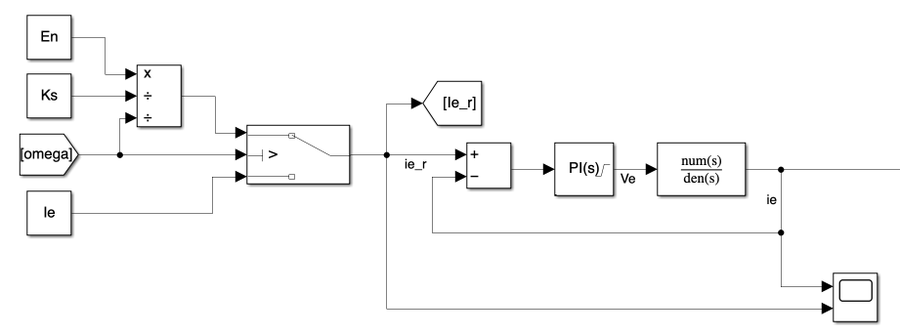
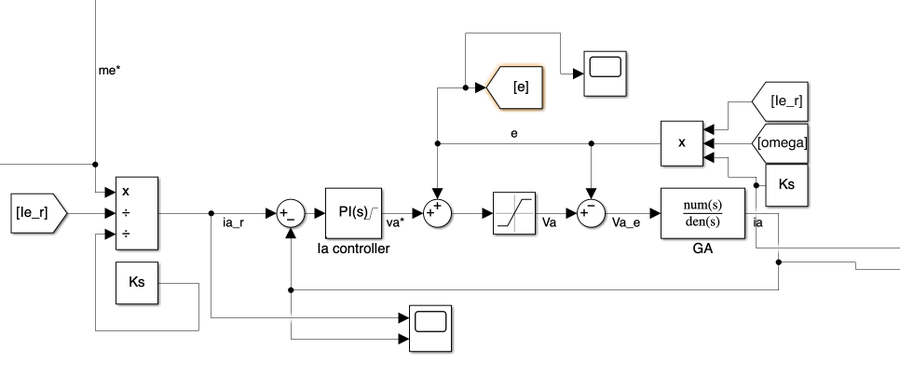
Additional features: back-EMF feedforward decoupling (cancels coupling between electrical/mechanical dynamics), anti-windup back-calculation (prevents integrator windup during saturation), rate limiter on speed reference (limits acceleration to 0.545 m/s² for passenger comfort, αmax ≈ 9.13 rad/s² at motor shaft), dynamic field-weakening above base speed (Ie,ref = En / (Ks·ω)).
02 Vehicle Speed — v(t)
<2% overshoot at FW entry Field weakening km 4–6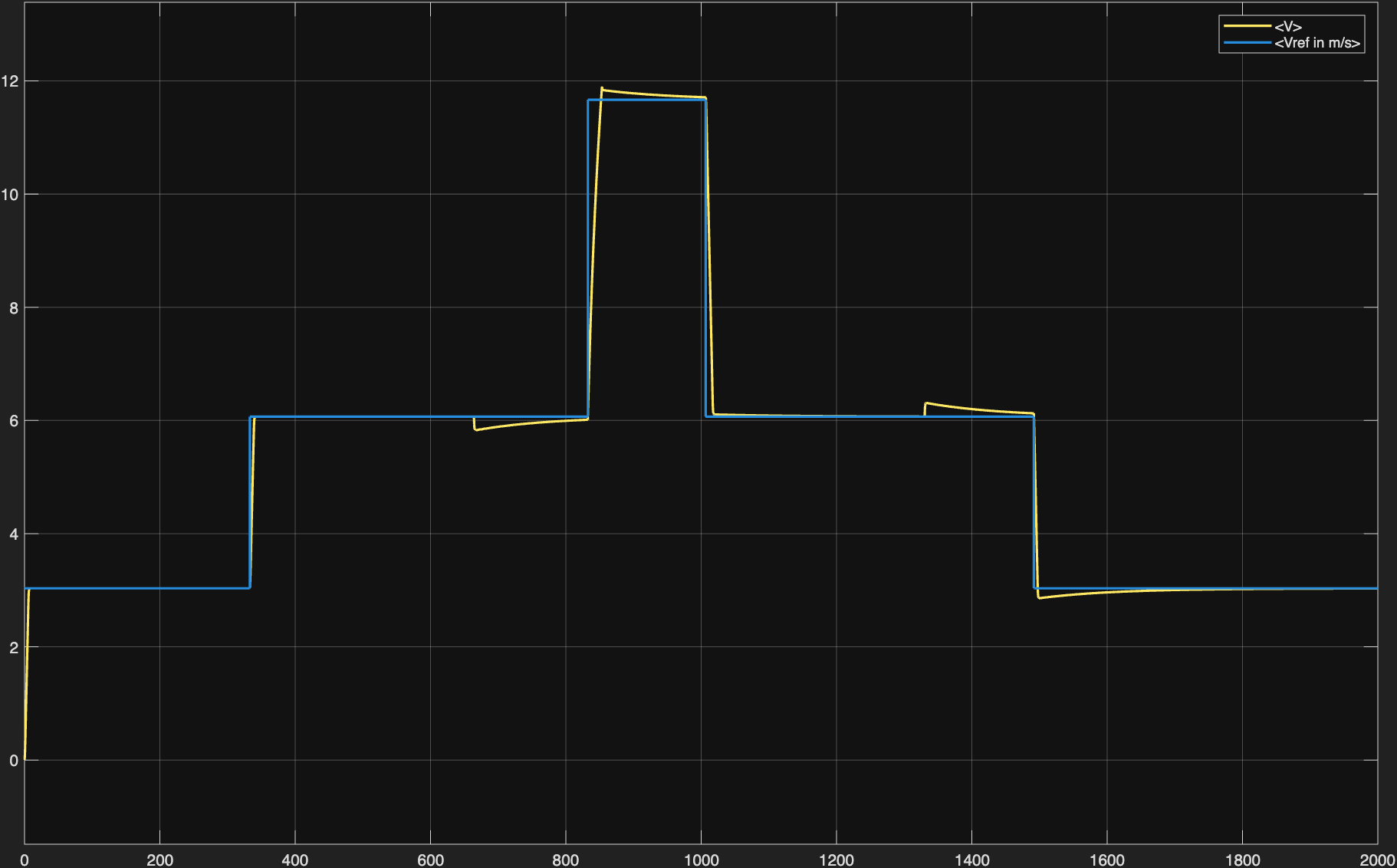
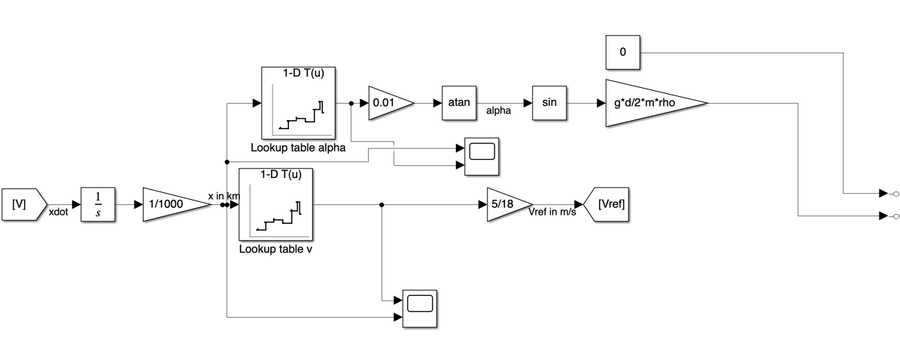
Speed profile confirms correct tracking of kinematic reference across all seven route segments. Rate limiter on ωref produces smooth linear ramps at each acceleration/deceleration phase, limiting acceleration to amax = 0.545 m/s² (passenger-comfort threshold, αmax ≈ 9.13 rad/s² at motor shaft).
PI speed loop, tuned with pole-zero cancellation, PM = 90° → tracks each reference step with negligible overshoot. A small blip below 2 % appears only at the transition to vmax, caused by the armature-current limit during the field-weakening transition. Validates bandwidth separation strategy (ωm = 2 rad/s).
Integral action of PI eliminates steady-state tracking error at constant speed, including in presence of slope disturbances (±5% at km 3–4 and 8–9).
At vmax ≈ 11.67 m/s motor operates above base speed. Speed tracking remains accurate despite excitation current dynamically reduced below nominal.
At km 3 (uphill +5%) Tdist = 743 Nm — 89.8 % of Tn. PI integral action drives the steady-state error back to zero; the transient speed dip lasts τs = 1/ωm ≈ 2 s. On downhill (km 8) the armature current reverses for regenerative braking.
03 Armature Current — ia(t)
Clamped at 156 A Anti-windup ✓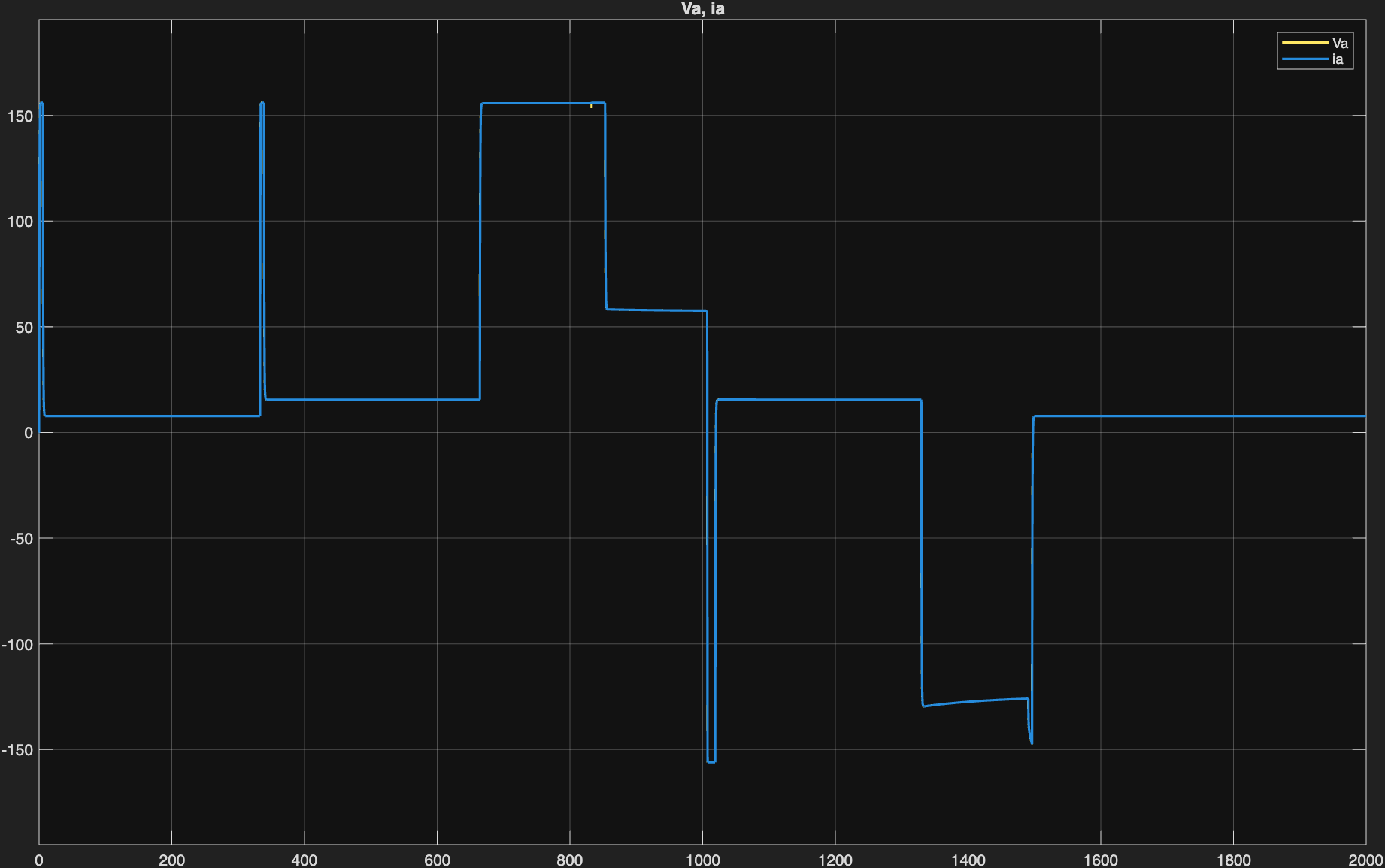
Armature current confirms inner PI loop correctly limits Ia to rated value 156 A during all acceleration phases. Back-calculation anti-windup (Kb,a = 100) prevents current spikes at transitions from saturation to unsaturated operation.
During acceleration ramps speed PI demands max torque. Saturation block clamps Ia at +156 A — max traction while protecting motor windings from thermal overload.
Back-calculation (Kb,a = 100) prevents integrator windup. Transitions saturated → unsaturated: smooth — no current spikes that would trip electrical protection.
At constant speed on flat track Ia only overcomes viscous friction (β = 0.81 Nms) → low steady-state value, efficient operation. On the 5 % uphill the gravity component alone draws ≈ 140 A; with friction included the total approaches the saturation limit of 156 A.
During deceleration km 9–10 armature current reverses → regenerative braking. Negative Ia confirms motor acts as generator, feeding energy back to DC line.
04 Excitation Current — ie(t)
Field weakening active Ie,min ≈ 2.6 A ✓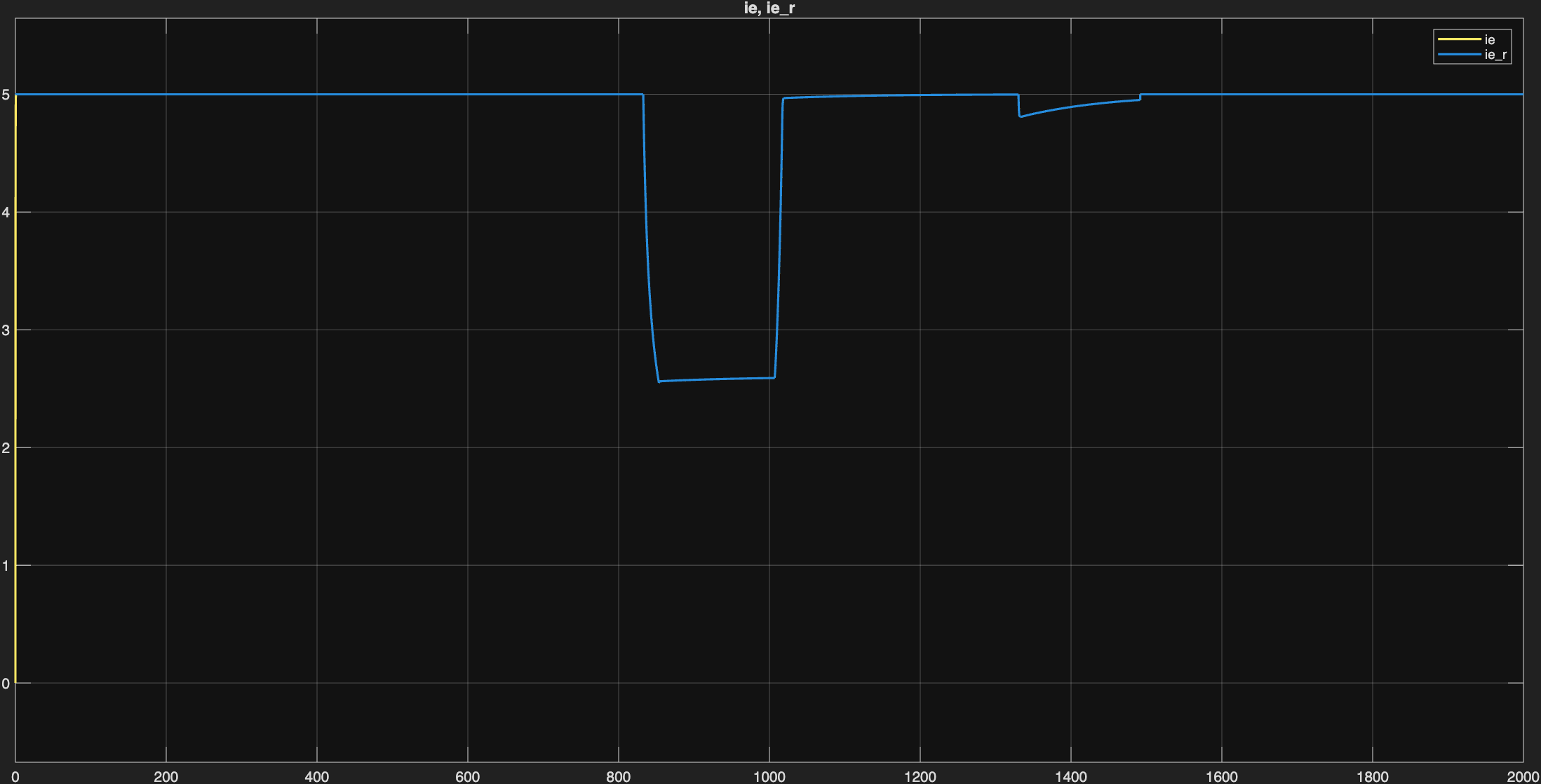
Excitation current plot validates field-weakening strategy. Current holds at nominal 5 A until base speed reached. Beyond this point controller dynamically reduces excitation via 1/ω law — keeps back-EMF below 600 V DC supply.
In base-speed region Ie held at nominal 5 A. Excitation PI (ωe = 40 rad/s, PM = 90°) tracks constant reference without error.
As ω exceeds ωbase = 101.6 rad/s: Ie,ref = En/(Ks·ω). At ωmax = 195.3 rad/s (vmax = 42 km/h) the reference drops to ≈ 2.60 A; the resulting back-EMF e = Ks·Ie·ω = 538.8 V stays 0.05 % below En, strictly under the 600 V line voltage. Constant-power region spans a factor 1.92 in speed.
Transitions into/out of field-weakening region smooth — no underdamped oscillations. Validates 90° phase margin design for excitation loop.
When speed ref drops below ωbase at km 6, FW block restores Ie,ref = 5 A. Excitation PI tracks step without overshoot.
05 Key Control Diagrams
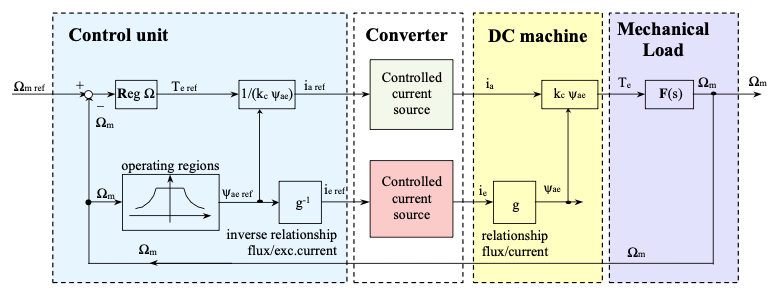
Simulink diagrams illustrate main control subsystems. Cascade architecture decouples three loops via bandwidth separation (factor ≥ 10× between adjacent loops).
06 Conclusions
Cascade PI architecture proves capable of controlling Carelli 1928 tram drive across full operating envelope — rated-speed traction, above-rated field-weakening, slope disturbances — while respecting every electrical and mechanical constraint.
Three design decisions proved essential: interpreting Kt as total machine constant Ks (verified by dual KVL/power-balance check), strict bandwidth separation (40/20/2 rad/s) for independent loop stability, back-calculation anti-windup to prevent integrator saturation during frequent current-limiting events typical of urban traction cycles.
Project submitted for course Dynamics of Electrical Machines and Drives (10 CFU) — MSc Automation and Control Engineering, Politecnico di Milano, under supervision of Prof. Francesco Castelli Dezza.